

The end of third-party cookies isn’t a setback; it’s a chance for brands to build deeper trust and achieve better results with privacy-first marketing. Agencies like Sapphire Digital Agency are already helping clients navigate this change. They turn data scarcity into a competitive advantage with consented, first-party strategies.
Why third-party cookies are really ending
Third-party cookies, which were essential for cross-site tracking and personalized ads, will be phased out across major browsers by mid-2026. Google Chrome’s timeline has shifted several times, but since Safari and Firefox already block them, over 80% of marketers have depended on this technology for targeting and attribution.
The impact is significant:
- Retargeting fails. Users cannot be tracked across sites with the same accuracy, disrupting dynamic ads and frequency limits.
- Attribution gaps widen. It’s harder to track multi-touch journeys without cross-domain signals.
- Personalization suffers in the short term. Behavioral profiles built on shadow data disappear, prompting a reconsideration of audience building.
Sapphire Digital Agency helps clients view this not as a loss, but as a shift toward higher-quality, consented data that provides better ROI over time. Brands that adapt early report a 10-25% increase in performance through cleaner data practices.
First-party and zero-party data: the new foundation
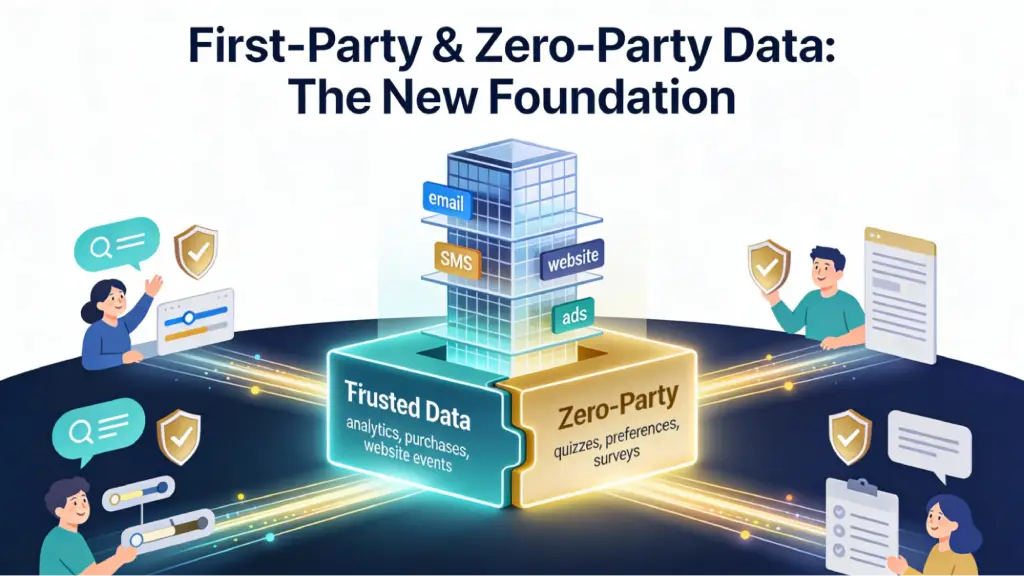
With third-party signals fading, first-party data (collected directly from your site or app) and zero-party data (explicitly shared by users) become the gold standard. Consumers willingly share preferences when the value exchange is clear.They engage with quizzes, loyalty programs, preference centers, and personalized recommendations in return for their input.
Digital Agencies builds these strategies around:
- Zero-party collection: Interactive quizzes like “What’s your skincare routine?”, preference quizzes, and polls reveal intent without tracking. Brands using these methods see 25-40% higher engagement and 15-25% increases in average order value.
- First-party enrichment: Server-side tracking, login incentives, and post-purchase surveys help capture emails, preferences, and behaviors on owned properties.
- Unified profiles: Customer Data Platforms (CDPs) combine data across touchpoints using email or hash matching to create detailed profiles for activation.
This shift resolves the privacy paradox. Users receive relevant experiences without invasive cross-site tracking, while brands gain valuable insights with full consent.
Privacy Sandbox, contextual targeting, and new tools
Google’s Privacy Sandbox APIs (Topics, Protected Audience, Attribution Reporting) provide partial alternatives, but adoption is still low since user choice is a priority. Instead of relying only on these, Sapphire Digital Agency suggests using a diverse combination:
- Contextual + first-party targeting: Match audiences based on page content, declared interests, and lookalikes created from your CRM data.
- Server-side tracking: Route pixels through your domain to capture events while keeping privacy intact.
- Privacy-Enhancing Technologies (PETs): Data clean rooms, differential privacy, and federated learning allow insights without revealing raw data.
For measuring success, cookieless attribution models recognize assisted conversions across separate platforms (email, app, direct) and utilize probabilistic matching using hashed identifiers. Sapphire Digital Agency combines these with GA4’s enhanced conversions and CRM data for complete visibility.
Building trust: the ultimate marketing moat
Privacy-first marketing isn’t just about following rules; it builds trust. In 2026, transparent brands will earn loyalty as consumers choose companies that clearly explain how they use data and offer control.
Key practices Sapphire Digital Agency implements:
- Clear value exchanges: Share your size preference for tailored recommendations” with visible privacy controls.
- Human-readable policies: Simple language that explains what data powers each experience, along with one-click preference centers.
- Ethical AI personalization: Use agreed-upon data to enhance on-site experiences, dynamic content, and email/SMS flows without unwanted tracking.
Brands that focus on this see higher engagement, with 2-3 times more recommendation clicks, and better retention as trust leads to repeat business.
How Digital Marketing Agency's 2026 privacy-first roadmap
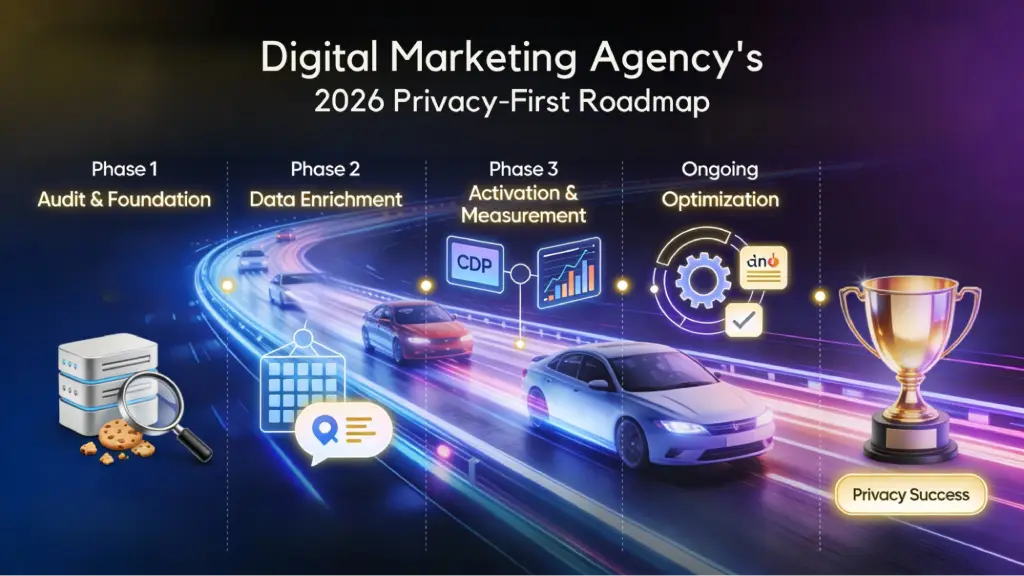
Successfully transitioning requires phased execution. Sapphire Digital Agency follows this proven framework:
Phase 1 (Months 1-2): Audit & Foundation
- Map third-party dependencies and phase them out.
- Deploy server-side tracking and consent management.
- Launch zero-party data collection through quizzes and preference forms.
Phase 2 (Months 3-4): Data Enrichment
- Implement progressive profiling across the site, email, and app.
- Build first-party audiences for Meta and Google Ads.
- Test contextual targeting alongside CRM lookalikes.
Phase 3 (Months 5-6): Activation & Measurement
- Deploy a CDP for unified profiles and segments.
- Launch personalized experiences, including product recommendations, content, and email.
- Set up cookieless attribution blending direct, organic, and paid signals.
Ongoing: Optimization
- Monitor Privacy Sandbox adoption and refine strategies.
- Conduct A/B tests on consent messaging to maximize data capture.
- Perform quarterly privacy audits to stay prepared for regulations.
The competitive advantage of acting now
While others scramble in 2026, early movers with Sapphire Digital Agency will control consented audiences that others cannot access. First-party data creates a significant advantage: richer profiles, higher engagement, better attribution, and strong customer relationships built on trust rather than tracking.